
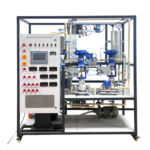
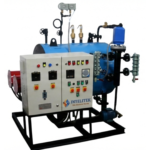
IES-PCI-414
Technical Specifications
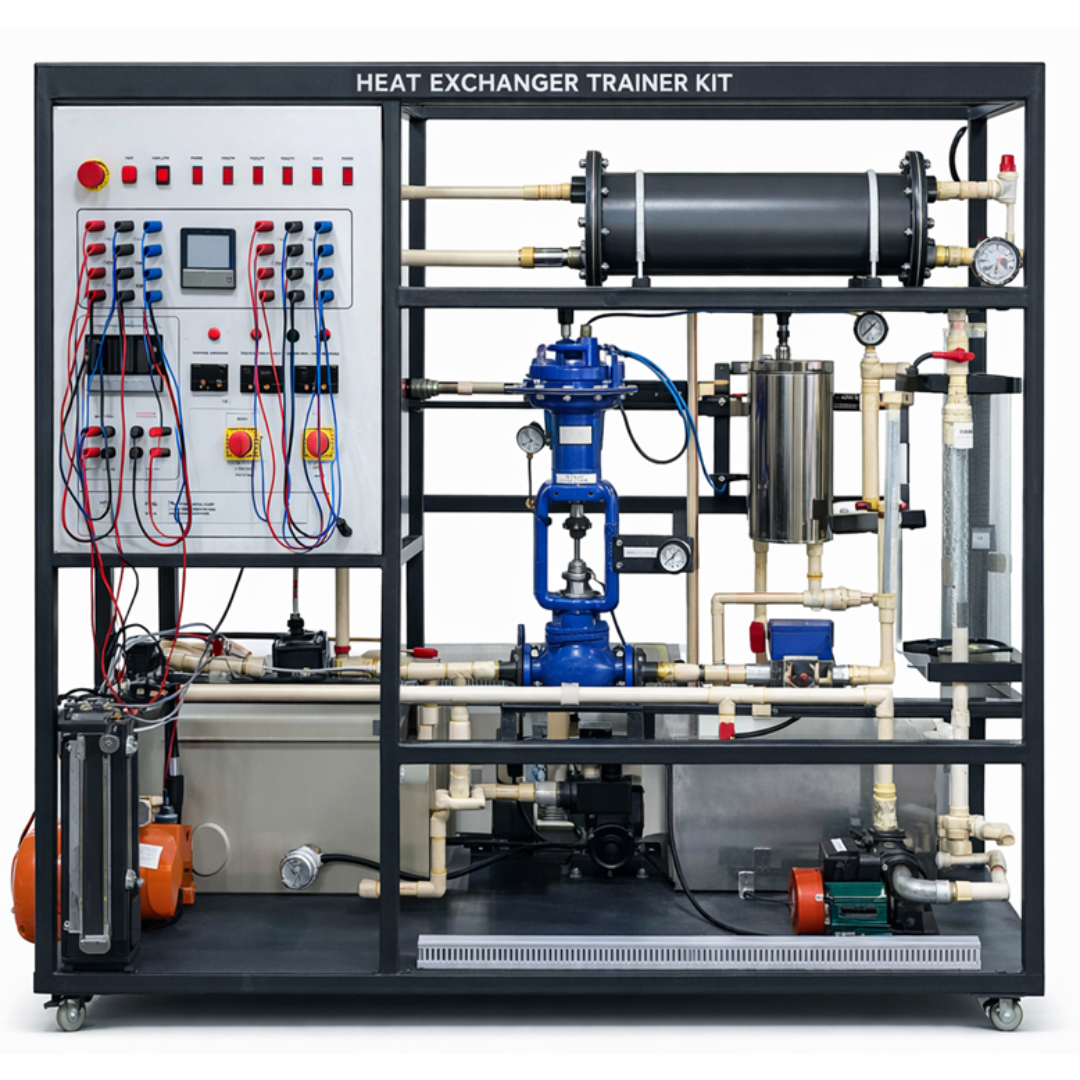
Hot Water Tank (HWT) – Polypropylene tank with 30–50 liter capacity and 3–5 mm wall thickness, designed for heating and hot water circulation experiments.
Cold Water Tank (CWT) – Stainless steel tank with 50 liter capacity and 2–3 mm thickness, used for cold water storage and circulation in heat exchange experiments.
Centrifugal Pump System – Two ½ HP centrifugal pumps operating on single-phase 230 V AC supply, dedicated for hot water and cold water circulation.
Heating System – Circular heater coil (1″ diameter) with side-mounted 1½″ connection, rated 3–4 kW, operating on 230 V AC, used for generating controlled hot water supply.
Process Piping Network – Industrial ¾″ CPVC / ½″ stainless steel piping system with ball valves and leak-proof fittings for safe water circulation between tanks and heat exchanger.
Flow Measurement Units – Two rotameter flow meters with 100–1000 LPH measurement range, glass tube or acrylic body construction, and ½″ process connections.
Heat Exchange System – Shell-and-tube or plate type heat exchanger with copper tubes capable of handling temperatures up to 100 °C for heat transfer studies.
Temperature Measurement and Monitoring – Pt100 RTD temperature sensors (4 Nos.) with ½″ BSP connection, along with a four-point temperature indicator displaying temperature range 0–100 °C.
Control and Pneumatic System – Includes pneumatic control valve (½″ equal-percentage type, Cv 5 US GPM), electro-pneumatic (E/P) converter converting 4–20 mA to 3–15 psi, FRL unit, bi-metallic thermostat, and PID controller with 4–20 mA I/O and PV/SP display.
Electrical, Air Supply, and Mechanical Structure – MS powder-coated electrical control panel with switches, indicators, DIN-rail terminals, and organized wiring; 50 L air compressor (1–2 HP) providing 5–6 kg/cm² working pressure; all mounted on a rigid MS skid frame with caster wheels for mobility.
KEY FEATURES
Demonstration of single-loop P, PI, PD and PID temperature control
Step response & transient behaviour analysis
Manual & Auto tuning for controller dynamics understanding
External PLC/DCS integration capability
Safe, mobile design with MS powder-coated frame and caster wheels
Industrial-grade components for realistic training
Emphasis on industrial safety practice
MECHANICAL CONSTRUCTION & DIMENSIONS
Type: Floor-mounted trainer kit with four heavy-duty caster wheels (locking/brake)
Overall Dimensions (Approx.): 6 ft (L) × 2.5 ft (W) × 5.5 ft (H)
Construction: Rigid industrial structure suitable for continuous laboratory use
RANGE OF EXPERIMENTS
Heat exchanger temperature dynamics study
Single-loop P, PI, PD and PID temperature control
Manual vs auto tuning of PID controller
Step response and transient behavior analysis
Effect of flow rate on heat transfer
Pneumatic control valve behavior in temperature regulation
Integration with PLC/DCS/SCADA systems
GENERAL
Application: Heat Exchanger & Temperature Control Training
Mounting: Floor-mounted mobile trainer
Safety: Thermostat protection, regulated air supply, proper earthing, and electrical protection


Reviews
There are no reviews yet.